

- Singapore runs two separate periodic inspection regimes for existing buildings, both administered by the Building and Construction Authority and both placed squarely on the building owner rather than on the authorities.
- The two regimes are easy to confuse, so it is worth setting them out against each other.
- Neither regime runs on a date the estate chooses.
- The Structural Engineer carries out a visual inspection of the structural elements and forms a view on whether the building remains safe for its intended use.
- Facade inspection begins with a visual survey of the whole external envelope, typically supported by close-range inspection of a representative sample.
Quick answer: Periodic facade inspection applies to buildings taller than 13 metres and over 20 years old, and must be repeated every seven years. Periodic structural inspection runs every five years for non-residential buildings and every ten years for residential ones. Both are the building owner's responsibility.
Most councils meet the periodic inspection regime the same way: a letter arrives from the Building and Construction Authority, nobody is quite sure what it means, and the estate loses two months working out who to appoint. The requirements themselves are not complicated. What catches estates out is the timing, the paperwork, and the assumption that the managing agent will simply handle it without a budget behind it.
This guide explains what periodic facade inspection and periodic structural inspection require, who has to act, what each inspection actually involves, and how to plan for the next cycle before the notice lands.
What Periodic Building Inspections Are
Singapore runs two separate periodic inspection regimes for existing buildings, both administered by the Building and Construction Authority and both placed squarely on the building owner rather than on the authorities.
Periodic structural inspection, usually shortened to PSI, is a visual inspection for visible cracks and/or irregularities in the building's structural elements, to confirm it remains safe for its intended use. Periodic facade inspection, or PFI, inspects the external envelope for deterioration that could fall or fail. They are different inspections, carried out by different professionals, on different cycles. An estate that has completed one has not satisfied the other.
For a strata development, the management corporation is the owner of the common property, so these obligations sit with the MCST and are discharged in practice by the managing agent under the council's direction. That makes them part of the same compliance load as fire safety servicing and lift maintenance, and they belong on the same calendar as your building maintenance inspection checklist.
PSI and PFI Side by Side
The two regimes are easy to confuse, so it is worth setting them out against each other.
Periodic Structural Inspection (PSI)
- Frequency. Once every five years for non-residential buildings, once every ten years for residential buildings.
- Who carries it out. A qualified Structural Engineer, sourced through the Professional Engineers Board or the published list of PSI engineers.
- What it examines. The load-bearing structure and whether the building remains safe for its intended use.
- Exemptions. Detached, semi-detached, terraced and linked houses used exclusively for residence, plus temporary buildings.
Periodic Facade Inspection (PFI)
- Frequency. Once every seven years, for buildings more than 20 years old and taller than 13 metres.
- Who carries it out. A Competent Person appointed by the owner. The CP may delegate to a Facade Inspector, but only under the CP's direct supervision and control.
- What it examines. The external facade and anything attached to it, looking for deterioration, spalling, loose fixings and failure risk.
- Exemptions. Buildings whose highest point is 13 metres or lower, roughly three to four storeys, as well as detached, semi-detached, terraced and linked houses used as residences, and temporary buildings.
- Legal basis. The Building Control (Periodic Inspection of Buildings and Building Facades) Regulations 2021, in force since January 2022.
The practical takeaway for a residential estate: your structural cycle is ten years, your facade cycle is seven, and once the building passes 20 years old the facade obligation begins, provided it stands taller than 13 metres, which covers most condominiums but not every low-rise strata development. Those cycles will not line up, so they need tracking separately.
When the Notice Arrives, the Clock Starts
Neither regime runs on a date the estate chooses. The obligation is triggered by a notice from the authorities, and the deadlines that follow are fixed. The estate must appoint the right professional, allow time for the inspection, deal with whatever the inspection finds, and submit the report within the window given.
No managing agent can tell when BCA will issue the notice for PSI or PFI, so the practical safeguard is financial rather than calendar-based. A vigilant managing agent will raise the estimated cost of both inspections at a General Meeting of the MCST and set it aside through the sinking fund, so the money is already in place when the notice arrives. Appointing the inspector is a legal obligation of the MCST, not a discretionary spend, so a council cannot treat it as something it has no mandate to fund.
It is also worth noting that not every approval has to wait for a council meeting. Where the management agreement allows it, routine appointments within an approved budget can be confirmed by email, which can save weeks on a fixed deadline.

What a Periodic Structural Inspection Involves
The Structural Engineer carries out a visual inspection of the structural elements and forms a view on whether the building remains safe for its intended use. Where the visual inspection raises concerns, the engineer may call for a more invasive investigation, such as opening up finishes, testing materials, or carrying out a full structural assessment.
That second stage is the one estates rarely budget for. A straightforward inspection is a predictable cost. A follow-up investigation and any resulting rectification is not, and it can be substantial on an older development. Estates that treat the sinking fund as a long-term capital reserve rather than a buffer tend to absorb this comfortably, which is one more reason the fund's adequacy belongs on the council's agenda alongside the management fund, sinking fund, and special levy.
What a Periodic Facade Inspection Involves
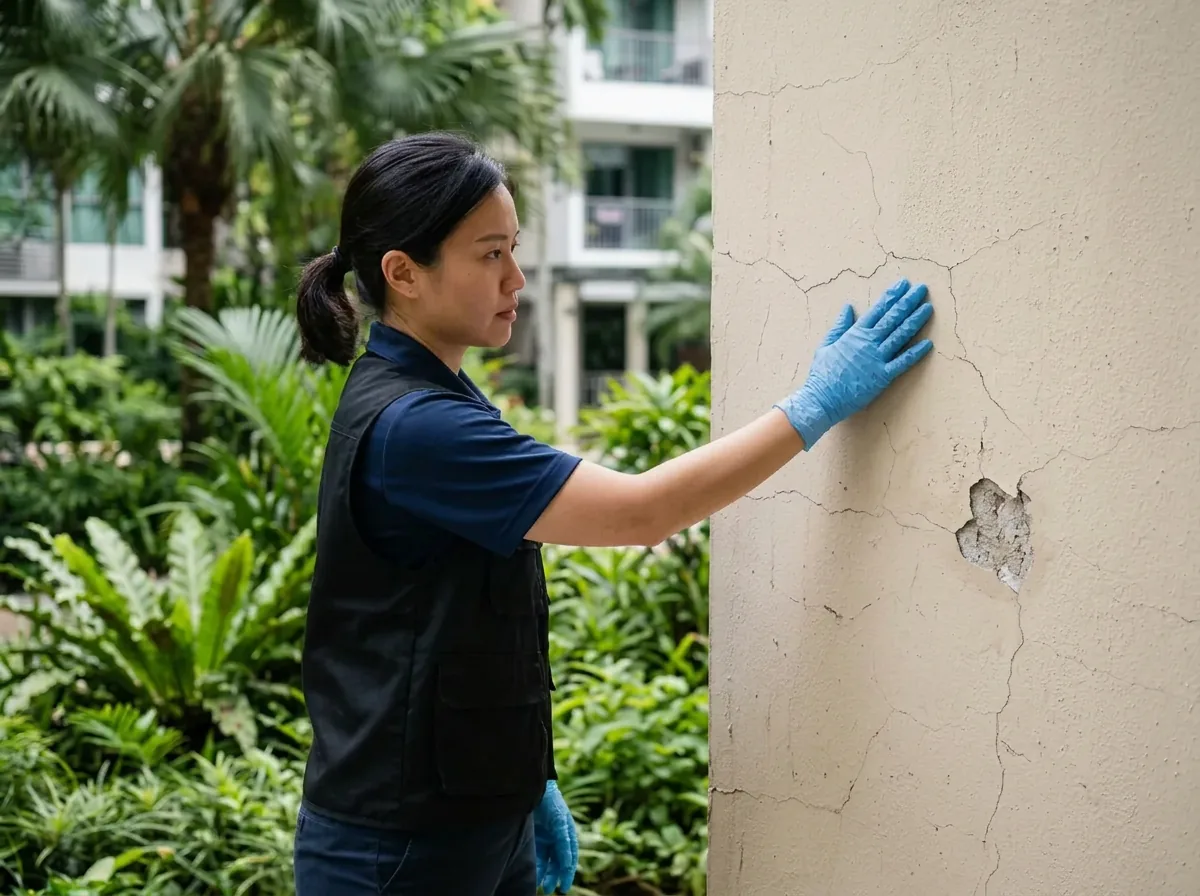
Facade inspection begins with a visual survey of the whole external envelope, typically supported by close-range inspection of a representative sample. Access is the practical constraint: a high-rise facade cannot be assessed properly from the ground, so the Competent Person will usually need rope access, a gondola, or drone survey to reach the sample areas.
The inspection looks for spalling concrete, cracked or debonded render, corroded fixings, failed sealant, loose cladding and anything attached to the facade that could work loose over time. Air-conditioner brackets, signage and architectural features all fall within scope, because the risk being managed is something falling from height onto a resident or a passer-by.
Where defects are found, the estate must rectify them and the Competent Person reports accordingly. On an older development this frequently runs into repainting and repair works that the estate may have been deferring anyway, so there is often sense in aligning the facade cycle with planned cyclical repainting rather than treating them as two unrelated projects.
Budgeting for Periodic Inspections
Costs vary considerably with the size, height and condition of the development, so any figure quoted without seeing the building is guesswork. What a council can plan for is the shape of the spend rather than the number.
- The professional fee for the inspection itself, which is predictable and can be tendered.
- Access costs for facade work, which are often larger than the inspection fee on a high-rise.
- A contingency for investigation or testing if the first-stage inspection raises concerns.
- Rectification works, which are the genuine variable and should be provided for in the sinking fund rather than the operating budget.
Treating the inspection fee as the whole cost is the most common budgeting error. The inspection is the cheap part. What it uncovers is what the estate actually pays for.
Where Estates Get Caught Out
The failures are consistent across developments and almost all of them are administrative rather than technical.
- No provision has been made in the sinking fund, so the notice arrives with nothing set aside to pay for it.
- The cost is treated as optional, when appointing the inspector is a legal obligation of the MCST.
- Building records, previous reports and as-built drawings cannot be located, which slows the professional down and increases the fee.
- Rectification is scoped but not funded, so the works stall between the report and the next general meeting.
- The PSI is completed and everyone assumes the facade obligation is covered too.
Every one of these is a record-keeping and forward-planning problem, which is precisely what a managing agent is appointed to prevent.
How Abacus Property Manages Periodic Inspections
At Abacus Property, statutory cycles are tracked centrally rather than left to a site file. Inspection due dates, certificate expiries and servicing intervals sit in one place where both the site team and our head office can see them, so when a notice arrives it is actioned immediately, with the estate's previous reports and building records already to hand. We also raise the expected cost of each inspection at the General Meeting, so it is provided for in the sinking fund before the notice lands.
Our compliance team applies the same process across every estate we manage, which matters because compliance failures usually come from inconsistency rather than ignorance. When an inspection is due we prepare the scope, assemble the building records the professional will need, and put a properly comparable set of quotations to the council rather than a single name.
Close supervision of the appointed vendor matters just as much as the appointment itself, so the inspection and any rectification are carried out thoroughly rather than signed off unchecked, resulting in fewer surprises at the next cycle. Throughout, the council receives clear reporting on what is due, what has been done and what remains outstanding, without having to chase for it.
Planning Your Next Inspection Cycle
No managing agent can predict exactly when BCA will issue a notice, but the obligations themselves are certain, which makes being caught without funds hard to justify. If your development is approaching 20 years old and stands taller than 13 metres, the facade obligation is on its way. If your last structural inspection is more than a few years behind you, the next one is closer than it feels.
The practical step is to provide for both inspections in the sinking fund through a General Meeting, and to make sure your building records are in a state a professional can actually work from. If you would like that handled as part of your strata management arrangement, our team is happy to review where your estate stands. Get in touch with us to talk through your next inspection cycle.
Speak to Abacus Property about planning and funding your estate's statutory inspections.